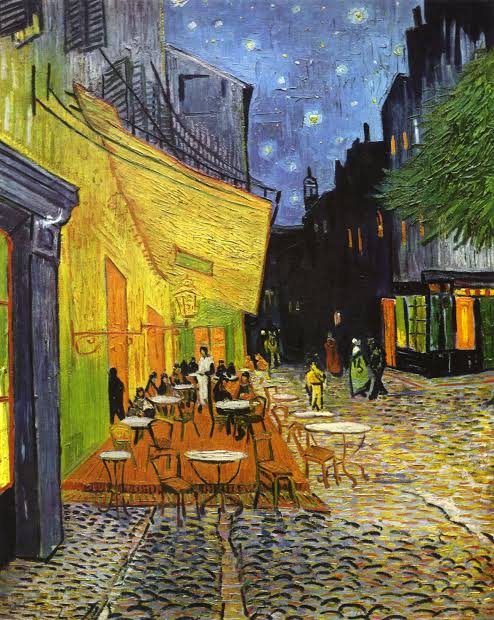
Van Gogh is born on 30 March 1853 in Groat Zundert, south Netherlands. From Childhood Van Gogh displayed a stubborn and moody spirit. His father was a Protestantd pastor, in his early life he initially chose to orient his life towards Protestantism, becoming a preacher in London, a theology student, and an evangelist in the mining populations of the Borinage region. He practiced painting and with the first traces of a dark work, marked by the misery of these miners, but to which Van Gogh attached a fervor and an exacerbated exaltation.

In 1886 he moved to Paris and lived with his brother. Teo ran a small picture gallery. He soon became acquainted with the young pointers driving the most innovative artistic movements. Influenced by the work of the Impressionists and Japanese artists, Van Gogh’s style began to evolve. The colors brightened, and the brushstrokes became more refined as they followed the shape of the object depicted. From 1888 onwards, he adopted the bold, brilliant colors found in the paintings of his French friends, and left Paris for the south of France. He began to use curved, swirling strokes and pure colors such as green and blue. After less than two months of working together, their relationship deteriorated seriously and ended in a famous quarrel in which Van Gogh threatened Gougin with a razor blade. The same night, he cut off his one ear. A few months later he voluntarily entered the Asylum at Saint Remy de Provence. His masterpieces belong to this period.
When we go back to the earliest times, we can delve deep into his art. Van Gogh started painting at the age of 27, experiencing a true case of “won late, lost early.” He passed away at the young age of 37, but his art remained immortal. Before becoming a painter, he tried working in different fields. He first worked as an art dealer, but things didn’t go as he had hoped. Later, he wanted to become a preacher like his father, but that didn’t last long either. Eventually, he decided to become a painter. During this process, his brother Theo supported him. He loved village life and incorporated it extensively into his art. In his letters to Theo, he expressed his thoughts as follows:
“When we think about all the things we don’t know the reason for, what else can a person do but go and look at a wheat field? The history of those plants is like ours; because we, who live on bread, are we not, to a considerable extent, like wheat ourselves? … And just like them, won’t we also be harvested when we have ripened?”
To understand more closely, he lived a peasant’s life, went to the fields with them, and endured harsh weather conditions like they did. Throughout his life, he had a special bond with his brother Theo, constantly writing letters to him. In another letter, he said:
“Teo, be a painter, try to save yourself, and come to Drenthe… So, my son, come and paint with me in the heath and potato fields. Come and walk with me behind the plow and the shepherd. Come and sit with me and watch the fire. Let the storm blowing in the heath also blow inside you.”
I mentioned that Teo had a special relationship with Van Gogh. In one of his letters, Teo advised Van Gogh to reduce the dark tones in his works and use brighter colors. After this advice, Van Gogh started creating much more colorful works compared to before, marking the beginning of a new period in his art and career. In a letter to Teo, he redrew one of his famous works and added a note saying, “I believe there is life in it.” He was truly right—his work contained a piece of real life.

He was influenced by Jean-François Millet’s works, which depicted rural life. Millet compared his artistic journey to the life of a peasant.
“When Van Gogh began making more colorful works on Teo’s advice, he entered a new period in his art. In this period, the color he used most was yellow.”
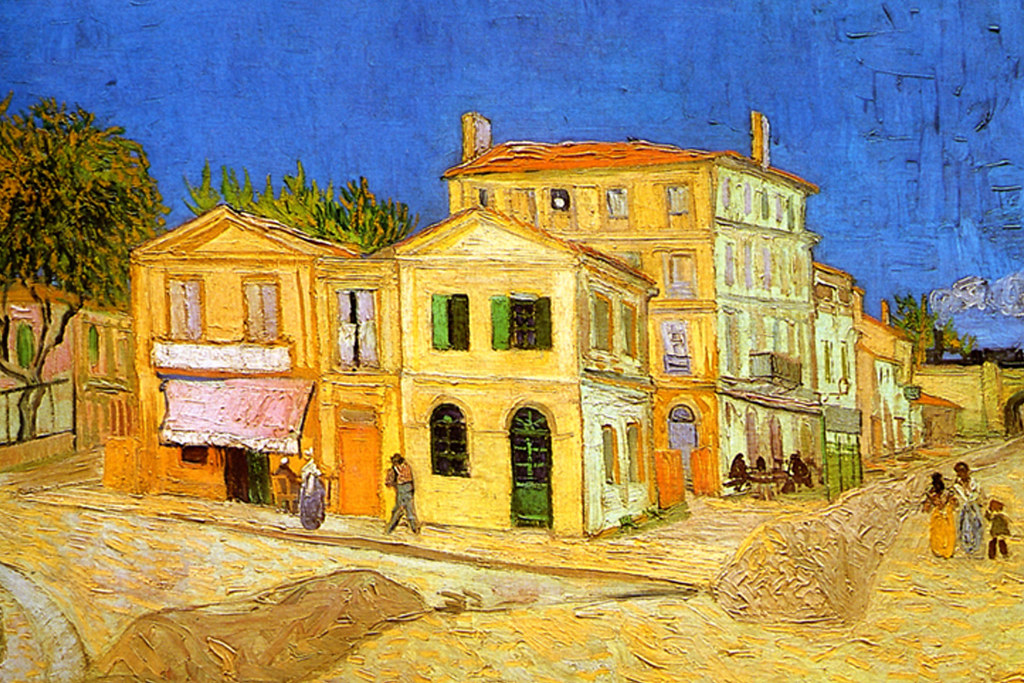
We can see in his works that he loved the harmony of yellow and blue. Even in his self-portrait, he painted human skin in yellow. He usually used these two colors together. He also showed rural life in strong yellow and blue. The clearest example of this is his paintings of wheat fields.


He painted not only wheat fields but also flowers in yellow, no matter their type or color. Van Gogh did not paint flowers only to show an ideal of beauty; he also painted those that had wilted and fallen to the ground.
He compared flowers to wheat grains; for him, they never truly disappeared. Even if they withered, their seeds would sprout again somewhere else. A strong Japanese influence can be seen in a large part of his art. In his Almond Blossom painting, for example, he was inspired by Japanese cherry blossoms. He also reflected the Japanese style of avoiding shadows in many of his works.
Van Gogh took his own life at the age of 37, leaving behind unforgettable works created in just 10 years of painting. His psychological struggles, from his perspective, cast a shadow over his art and held him back. Today, we see his works all around the world.
 rtnews