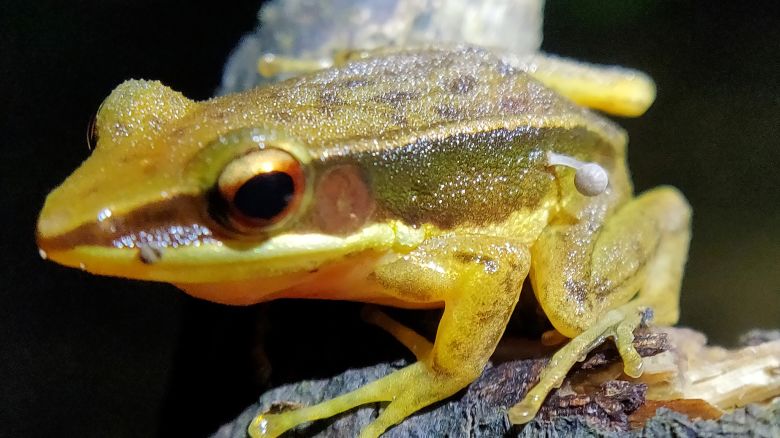
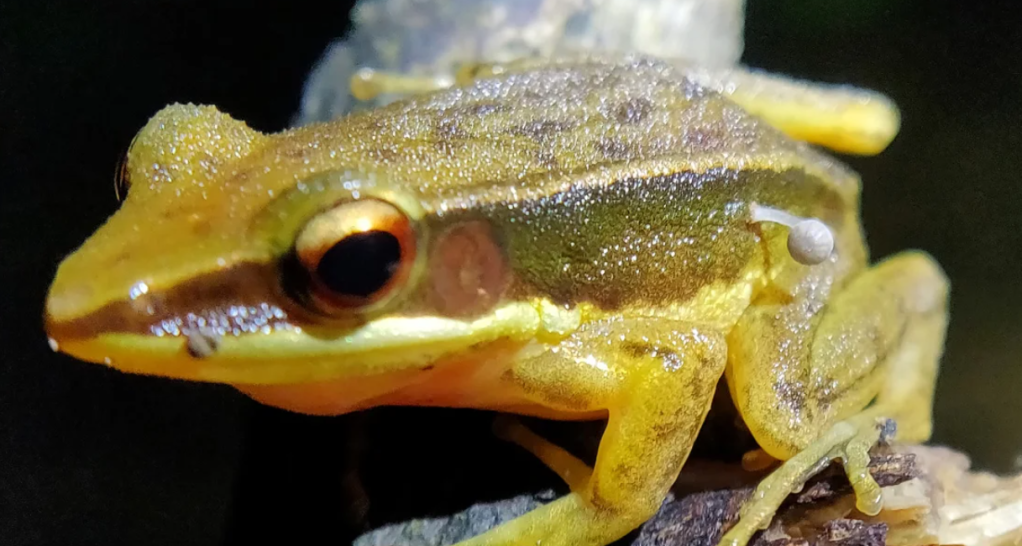
In a remarkable and unprecedented discovery, a frog in the lush landscapes of Karnataka, India, has become the host to an extraordinary growth – a miniature mushroom protruding from its side. This peculiar phenomenon, hitherto unobserved by scientists, has left researchers in awe and bewilderment.
The groundbreaking observation occurred as a team of naturalists examined a group of golden-backed frogs inhabiting a roadside pond in Karnataka. Among these amphibians, one individual stood out with a minuscule mushroom sprouting from its flank, presenting an enigma that scientists are struggling to comprehend. The startling revelation was documented in a note published in the journal Reptiles and Amphibians in January.
Lohit Y T, a specialist in rivers and wetlands associated with World Wildlife Fund-India in Bengaluru, was part of the team that made this astonishing discovery. Expressing his amazement, Y T stated, “When I first observed the frog with the mushroom, I was amazed and intrigued by the sight. My thought was to document it, as this phenomenon is something we have never heard of. We just wanted this to be a rare incident and not a dangerous phenomenon for the frog.”
The frog in question belongs to the species known as Rao’s intermediate golden-backed frog, scientifically classified as Hylarana intermedia. These frogs are commonly found in the southwestern Indian states of Karnataka and Kerala and are characterized by their diminutive size, reaching a maximum length of only 2.9 inches (7.4 centimeters).
During the observation, the naturalists noted that the frog, seemingly in good health, moved about its perch, shifting positions while the mushroom attached to its side remained steadfast. The group refrained from interfering with the frog, and as of the June 2023 sighting, the cause of this peculiar phenomenon and the fate of the frog remain unknown.
Subsequent analysis of images revealed that the mushroom growing from the frog’s flank is identified as a common bonnet, belonging to the Mycena genus. Typically found on rotting wood from deceased trees, this fungus is a saprotrophic decomposer, extracting nutrients from dead or decaying organic matter. Intriguingly, a 2023 study suggested the possibility of the Mycena fungus evolving to thrive on living plants, raising questions about its potential symbiotic relationships with them.
While the prognosis for the frog with its fungal companion is uncertain, several theories have emerged regarding the cause of this extraordinary condition.
One consideration revolves around the backdrop of a prevalent frog-killing disease in India known as chytridiomycosis. This fungal infection has affected over 700 amphibian species globally, with India currently facing an epidemic. However, researchers are hesitant to draw a direct link between the mushroom discovery and chytridiomycosis, emphasizing that the specific mushroom species is not closely related to the fungus causing the disease. Nonetheless, the possibility of the Mycena fungus altering the frog’s susceptibility to chytrid infection remains a subject of interest and further investigation.
In the realm of nature’s mysteries, the frog with a mushroom hitchhiker stands as a unique and intriguing enigma, challenging our understanding of symbiotic relationships and the adaptability of fungi in the wild.
 rtnews