
The person who complains cannot take action; complaining is an addiction and provides pleasure. The sensation of pain secretly gives us pleasure. When we don’t complain, when complaints arise from within, courage takes its place, and we begin to move. In our geography, there is a beautiful saying: “Movement is blessing.” This saying gives us peace.
So why does pain lead to pleasure? When reading the novel “Crime and Punishment,” do we only feel sadness? We don’t even want to imagine ourselves in Raskolnikov’s place, but not everyone thinks and feels this way. Some, while reading about the depressions and turmoil that Raskolnikov experiences, feel as if they are losing themselves in it, causing both pain and pleasure. Pleasure leads to the continuation of this desire, and people start clinging to pain. For pain to persist, the problem must persist. Therefore, instead of finding a solution, we allow the problem to occupy a longer space in our lives. This is embracing the pleasure. Actually, it is closing the emotional void with the pleasure given by pain. If there is no measure to this, a person can make themselves sick just by dwelling on their own thoughts. The prevalent condition today is a result of people not socializing, not finding their place in the social environment, and becoming isolated.

Whatever happens to a person comes from thinking too much. Unfortunately, all problems arise because a person cannot sit alone in a room. Not everyone can control their will. Willpower control is not only a strict attitude towards desires such as lust, money, or other topics. After a certain point, even suffering will push us beyond the normal. If the cause of pain is us and our thoughts, the only reason to sustain it is our pleasure. Why does a person do this to themselves? Unfortunately, as we age, many of us realize that the world is not just made up of the fairy tales we were told. As we move away from the world we desire, we begin to struggle in our own swamp. This is not a swamp for everyone; some people see these as small obstacles that can be overcome, while others turn their problems into their own hell. Therefore, many people experiencing the same problems react in very different ways. However, the people showing different reactions are beyond the scope of our topic. Today, we will closely examine the psychology of pain and the experience of pain.
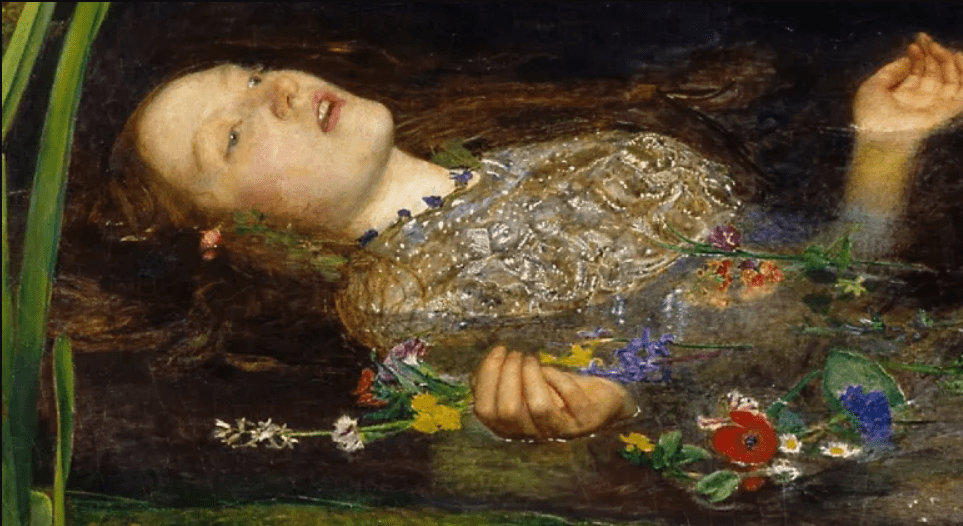
The first example, or perhaps the most original and ancient example we can reach, is Shakespeare’s Ophelia.
Ophelia is a character in the famous English playwright William Shakespeare’s tragic play “Hamlet.” “Hamlet” was written in the early 17th century and is considered one of his most famous works.
Ophelia is introduced as the daughter of Polonius and the lover of Hamlet. However, as the play progresses, she faces a tragic fate. Ophelia’s story contains a complex and poignant narrative involving love, betrayal, revenge, and madness.
Ophelia’s tragedy begins, particularly influenced by the behavior of her father Polonius and her boyfriend Hamlet. Hamlet’s strange behavior and his relationship with Queen Gertrude seriously affect Ophelia’s emotional and mental health. Hamlet’s attitudes towards Ophelia and his emotional turmoil eventually plunge Ophelia into deep depression.
Ophelia’s tragedy becomes even more complicated with the death of Polonius and Hamlet’s struggle for the throne. At a point where Ophelia thinks that her lover Hamlet has lost interest in her, she loses her sanity. Songs and monologues representing Ophelia’s madness are included in a section of the play.
The tragic end of Ophelia takes place by a river. Her death is portrayed as if she drowned or fell into the water. Her death deepens the tragedy, emphasizing the emotional pain and helplessness she experienced.
I find the modern reflection of the emotion of pain, especially in Attack On Titan. You might ask, what does these two examples have to do with each other? Yes, Attack On Titan does not have a character like Ophelia, but according to the purpose of the story, as the director also stated, it can be considered as a fundamental Ophelia. Sometimes people experience things that make them give up everything they hope for, everything they want to have. Here, I am talking about the character Eren. Eren fights incredibly to be free, but when he realizes that salvation is giving up his own freedom, he gives up everything and becomes a completely different person. Sometimes people have stories that leave them with no other options, and becoming the person they need to be becomes not a choice but a necessity. Attack On Titan is an anime that involves the struggle of humans against giants, so the story smells of despair from the beginning. In essence, it is the story of the struggle of man against man because it is not possible for all humans to live together in this story. I will write about the legend of Attack On Titan in detail in my next article, so I am presenting the story here superficially. If you wish, you can read it in detail in my next article.
Pain and Human Psychology
Humans experience pain as a crucial aspect of their evolutionary and psychological makeup. Pain serves as a protective mechanism, alerting individuals to potential threats and ensuring their survival. From a psychological perspective, pain is a complex phenomenon involving sensory, emotional, and cognitive components.
Sensory Component: Survival Instinct: Pain is a fundamental part of the human survival instinct. It alerts individuals to potential dangers and prompts immediate action to avoid harm. Learning Mechanism: Experiencing pain helps individuals learn from harmful situations, contributing to the development of adaptive behaviors.
Emotional Component: Emotional Processing: Pain is closely tied to emotions, such as fear and distress, which play a crucial role in shaping human behavior. Social Connection: Expressing pain can facilitate social support and empathy, reinforcing social bonds.
Cognitive Component: Learning and Memory: Painful experiences are often remembered vividly, aiding in the formation of memories that guide future behavior. Decision-Making: The avoidance of pain influences decision-making processes, promoting choices that prioritize safety and well-being.
While pain is a natural and adaptive response, there are instances where individuals may want to alleviate or manage it. Here are some strategies from a psychological perspective:
Cognitive-Behavioral Techniques: Cognitive Restructuring: Challenge and modify negative thought patterns associated with pain. Behavioral Techniques: Engage in activities that promote positive emotions and distract from pain.
Mindfulness and Meditation: Mindfulness Practices: Techniques such as meditation can help individuals develop awareness and acceptance of pain without unnecessary suffering.
Psychological Therapy: Counseling or Psychotherapy: Seek the guidance of a mental health professional to explore and address the emotional aspects of pain.
Social Support: Connection with Others: Share experiences with supportive individuals who can offer understanding and empathy.
Pain Management Programs: Multidisciplinary Approaches: Participate in programs that integrate various therapeutic approaches, combining physical and psychological strategies.
 rtnews