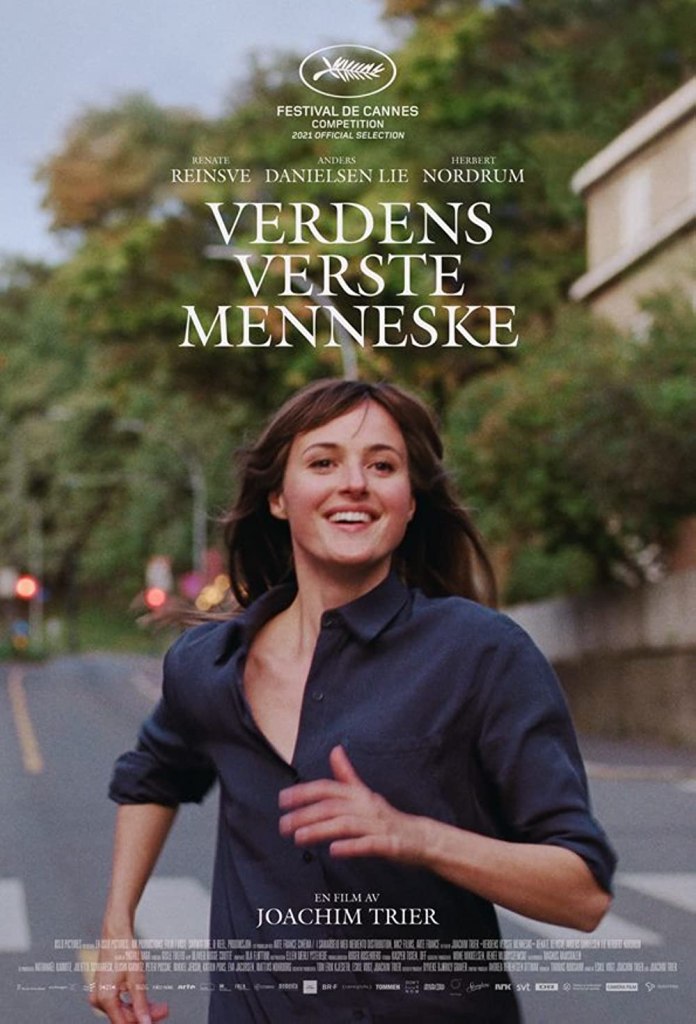
Before the weekend, let’s read something informal—a movie review on the trilogy by Joachim Trier.
In moments of indecision in our lives, we experience transitions of emotions. The word “emotion” comes from the Latin word “movere,” which means to move. Yes, our emotions move, meaning we go through emotional transitions. I will start by evaluating the last film in this trilogy, “The Worst Person in the World.” The film reflects on how our emotions govern our lives, depicting Julia’s story of winning and losing in life, or rather, the idea that there is no end. The film starts with a classic story that takes a different turn when Aksel enters Julia’s life. However, we follow the unseen inner emotional processes that affect a person’s mood as the story unfolds.
Even before meeting Aksel, Julia decides to study Medicine, initially driven by her hard work and success, seeking a profession admired and appreciated by society. However, realizing her lack of interest in the field, she switches to Psychology, adapting quickly and receiving praise and support for her courage from those around her. Throughout life, we experience emotional transitions and continue to question ourselves. Julia, who constantly questions herself, finds that psychology is not the final destination, discovering her true passion for photography, a world she had never entered before.
This world opens the door to a phase where her path will intersect with Aksel’s, bringing order to her life. As we get to know other women in Julia’s family in a section of the film, it becomes more than just a family study, providing a general perspective on women’s rights and the existing dominant family cultures. Julia, a young woman in her thirties, has a freedom space within her life, even though she sometimes does not feel free. Her mother has a similar life, and so does her grandmother. However, as the story expands and delves into the past, we see that there are underlying dominant family cultures where couples stay married out of obligation, not love. This is because women have become liberated over time, perhaps living in the era where they are most free.
We all perceive a movie we watch or an article we read from our own perspectives. What I see in this film is how freedom is portrayed. Does freedom truly make us happy? How healthy are our choices when we are free? Do we choose the right path? Or does the right path even exist?
Julia is at the center of all these questions. Although it may sound cliché, every choice is a sacrifice, and Julia, in her choices, experiences losing others while being happy on one side and conflicting with societal values on the other. Over time, we begin to stop loving the person we love. “We may not find the same person even in the same individual” – in this situation, perhaps most people choose to accept this, leading to one-sided love over time. However, I specifically mentioned “most people” because not everyone makes this choice, and Julia did not. Instead of standing still, she moved, lived her emotions instead of suppressing them, and could make radical decisions. She made herself free in every sense, but the problem is that not every freedom brings happiness. Therefore, in the film, we can see a peaceful Julia. She often knows how to have fun, allocates time for herself, reads a lot, writes, continues to take photographs. However, in society’s eyes, she always has an unfinished story, and no one knows that this might be her true state. Perhaps what is good and complete for society may be unnecessary, unwanted, or too distant for the individual in question. Maybe this individual choice can bring unhappiness, but in the end, the responsibilities lie with the individual who made that decision. Julia’s story is all about the choices we make for everything that burdens us, the emotions we want to show, and the tranquility we may choose. Because when the center of the self is at peace, choosing not to move, the order around it continues, similar to Aristotle’s concept of movement. The stillness of the central gear is required for order and movement. All gears moving simultaneously is like a person trying to walk on sand or a frog trying to jump in mud—there is no movement in either case.
When Julia sets her self in motion, we see time stand still in the film. Everything freezes except for her and her lover because this is necessary for this meeting or moment to happen. However, when time continues to flow, Julia is forced to make a choice. Because all gears moving simultaneously would disrupt the entire order, and she chooses to unite her life with the person she loves, leaving the one she was with. This choice results in her accepting responsibilities as an adult.
After a while, we realize that the life we observe from the outside eventually becomes our own. Julia is like a reflection of us, a part of us, and we begin to compare the anxiety situations she experiences with our own lives. If you are an individual who questions and contemplates your choices, feel free to share your thoughts here.
Wishing you enjoyable reading and watching.
 rtnews