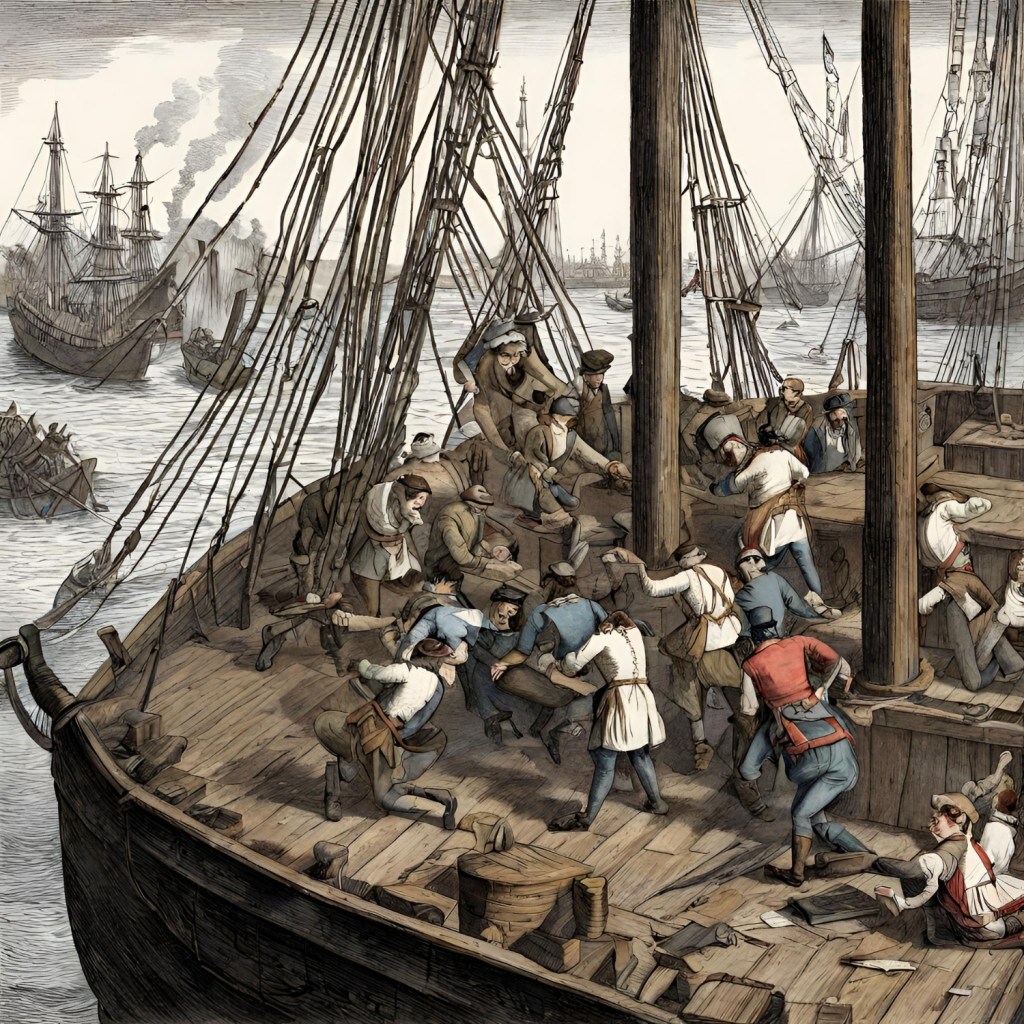
The Boston Tea Party was a pivotal event in American history that took place on December 16, 1773, and played a crucial role in the lead-up to the American Revolution. It was a protest against the British government’s imposition of taxes on tea imported to the American colonies.
Here’s a summary of the Boston Tea Party:
Background: In the years leading up to the Boston Tea Party, tensions had been escalating between the American colonies and the British government. The British Parliament had passed a series of acts, including the Stamp Act and the Townshend Acts, which imposed taxes on various goods and stirred resentment among the colonists who believed in the principle of “no taxation without representation.” The Tea Act of 1773 was the latest in a series of measures that intensified colonial opposition.
The Tea Act: The Tea Act was passed by the British Parliament in 1773, granting the financially troubled British East India Company a monopoly on tea sales in the American colonies. This meant that the East India Company could sell tea directly to the colonies without going through middlemen. While this would theoretically make tea more affordable for the colonists, they saw it as a ploy to undercut local merchants and to assert British control over colonial trade.
The Event: In protest against the Tea Act, a group of colonists, many of whom were members of the Sons of Liberty, dressed as Mohawk Indians to disguise their identities and boarded three British ships: the Dartmouth, the Eleanor, and the Beaver. On the night of December 16, 1773, these colonists, led by figures like Samuel Adams and Paul Revere, proceeded to dump 342 chests of tea into Boston Harbor.
Aftermath: The British government responded harshly to the Boston Tea Party. In 1774, Parliament passed the Coercive Acts (known as the Intolerable Acts in the colonies), which included the closing of Boston Harbor until the East India Company was compensated for the lost tea. This further fueled colonial anger and helped galvanize support for the revolutionary cause.
The Boston Tea Party became a symbol of colonial resistance and a rallying cry for those who sought independence from British rule. It marked a turning point in the relationship between the American colonies and the British government, ultimately contributing to the outbreak of the American Revolution in 1775.
American Perspective:
- Taxation Without Representation:
- Colonists were vehemently opposed to what they perceived as “taxation without representation.” They argued that they had no direct representation in the British Parliament, yet were subject to taxes imposed by the British government. The series of acts leading up to the Tea Act fueled a sense of injustice among the colonists.
- Economic Grievances:
- The Tea Act of 1773 was seen as a direct threat to local merchants and colonial trade. Colonists believed that the British government, by granting a monopoly to the East India Company, aimed to control and manipulate colonial commerce to the detriment of local businesses.
- Defiance and Symbolism:
- The Boston Tea Party was an act of open defiance against British authority. By dumping the tea into Boston Harbor, the colonists symbolically rejected the British-imposed tax and asserted their right to make decisions about their own governance and commerce.
- Solidarity and Unity:
- The event helped to unite the colonies against a common enemy. It served as a powerful symbol of resistance and solidarity, reinforcing the idea that the American colonists could stand together against British oppression.
British Perspective:
- Maintaining Control:
- From the British perspective, the Tea Act was intended to assert and maintain control over colonial trade. The British government believed that by granting the East India Company a monopoly on tea sales, they could stabilize the financially troubled company and exercise authority over the colonies.
- Enforcing Parliamentary Authority:
- The British government viewed the resistance in the colonies as a challenge to the authority of Parliament. They believed in the supremacy of parliamentary law and saw the colonists’ refusal to accept taxation without representation as a threat to the imperial system.
- Punitive Measures:
- In response to the Boston Tea Party, the British government enacted the Coercive Acts to punish Massachusetts and reestablish control. Closing Boston Harbor until the East India Company was compensated was seen as a reasonable measure to ensure order and obedience to British laws.
- Disapproval of Colonial Unrest:
- Many in Britain disapproved of the colonial unrest and saw the Boston Tea Party as a destructive act of rebellion. Some believed that the colonies needed to be disciplined to prevent further challenges to British authority.
Understanding these perspectives helps illuminate the complex dynamics that led to the American Revolution, a conflict born out of differing views on governance, representation, and the relationship between the colonies and the British Crown
 rtnews