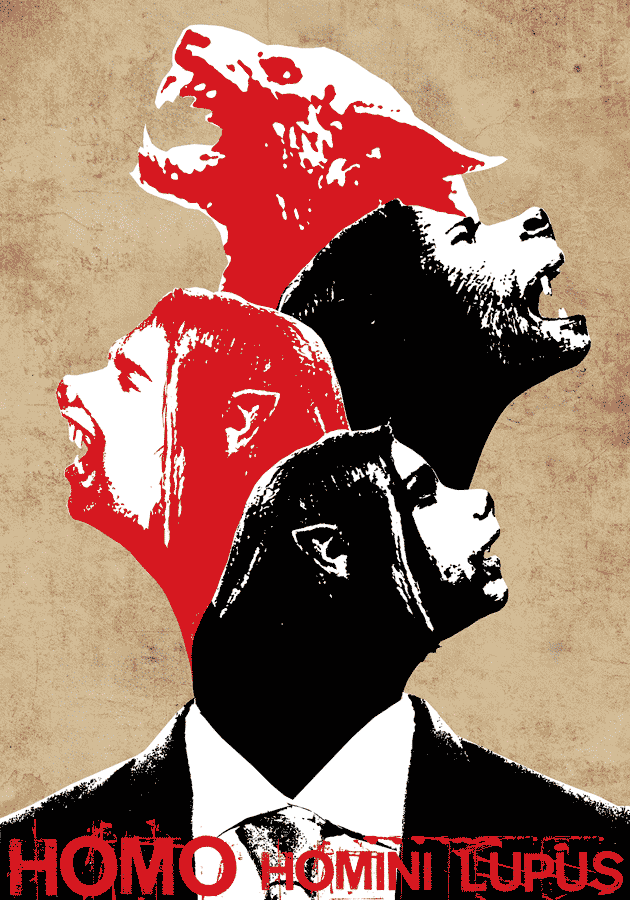
“Homo homini lupus” is a Latin phrase meaning “man is a wolf to another man”
According to Locke, features such as the ability to compromise and communicate are inherent in human nature. These characteristics have not been given by history but have always existed in humans and will continue to do so.
Rousseau, on the other hand, argues that humans do not possess an unchanging essence. He claims that the phenomenon of history, culture, and society introduces and transforms us. The effort and process invested in this transformation change us. The person who seeks a way to bring water from the top of the mountain to where they live and achieves it is no longer the same afterward; they cannot be. In this process, the effort and labor spent cause us to change and transform. This can be explained by the structure of history, according to which history is pedagogical, educating and transforming people.
“When Did We Sign the Social Contract?”

Hobbes and Locke approach this question with skepticism. According to Hobbes, the people in the newly discovered Americas can be cited as an example of this situation. According to Rousseau, however, he takes the concept of the social contract directly as a conceptual tool, beyond the historical fact.
The Relationship Between Enlightenment and Romanticism (18th Century Enlightenment)
The central focuses were France, Parisian salon life, and French intellectuals. In the 17th century, an informed and cultured intellectual class emerged against the remnants of feudalism. France, during the Reformation process, sustained heavy Catholic pressure. French intellectuals opposed this situation, advocating for a permanent attitude that prioritizes knowledge over belief principles. They argued for reformist steps under the leadership of science and reason. Although Rousseau is often thought of as a symbol or critic of Enlightenment, his intellectual identity contains contradictions. While advocating Enlightenment at the forefront, his works show a departure from Enlightenment and a glimpse of the first examples of Romantic thought. He both championed Enlightenment and continued the art of Romanticism against it.
Many Enlightenment intellectuals believed that civilization, life, and facts had always improved throughout history, holding a hopeful perspective. However, according to Rousseau, the historical process is a process of degeneration. In Rousseau’s view, humans in their natural state, described as “noble savages,” are more intelligent and conscious than us. There is no room for concern in the natural state.
How to Exit the State of Nature?
According to Hobbes, this situation is unsustainable, and leaving the state of nature is a necessary behavior. According to Locke, the state of nature is a peaceful environment, but an independent third eye is needed in this environment. This third eye is the state because, according to Locke, some situations in the state of nature will be unsustainable, and in such cases, the internal eye, the state, must come into play, and the formation of the state originates from here.
Rousseau argues that leaving the state of nature is not necessary. The natural state does not change; it degenerates because the concept of property distances and degenerates humans from their natural state. For example, the story of Adam and Eve with the apple represents the sending of humanity from a new perfect state to the world (degenerated, corrupted) and expulsion from paradise. With property, the natural state turns upside down; according to Rousseau, there is no concept of labor in the description of the natural state. Labor comes after the concept of property. The concept of property brings with it the concept of personal interest, making the individual selfish. Rousseau argues that whatever seems wrong or goes against our moral sensitivity in our civilization is due to the concept of property. Property is not something you claim by putting a fence around a piece of land and saying it’s mine; it originated from the first fool who believed it was yours. In this context, the social contract is not a threshold from the state of nature to the modern; rather, it is a movement to bring the deteriorated human condition with property back to an acceptable level. (Hobbes and Locke argue the opposite.) Since there was no social contract during the exit from the natural state due to the degeneration caused by property, where was the social contract accepted? The social contract is the phenomenon that, along with property, restores the deteriorated human condition to an acceptable level.
When looking at a society, these three thinkers have the following perspectives:
Rousseau: How does a contract settle things in this society? Hobbes and Locke: What kind of social contract did this society sign to end up like this?
No French intellectual or thinker witnessed the French Revolution. They passed away in the last quarter of the 18th century, much like Rousseau.
In a society where there is property, an individual is torn between being just and choosing their own interest. Rousseau: “If you have no thought other than your own interest, and this understanding of interest is consuming your personality, then an exchange cannot take place. But everyone has a sense of justice because, according to him, people cannot be concerned only with personal interests; there must be a sense of justice somewhere within them. For a society to form, for me to be able to sit next to my neighbor and engage in trade, there must be a sense of justice within me somewhere. This is called “private will,” an internal force that resorts to justice and allows us to make decisions. Private will is not normative, it is not moral. It is an extremely cold and self-leaning will, but it is not bad; everyone must have it because every person inherently possesses this phenomenon.”
 rtnews