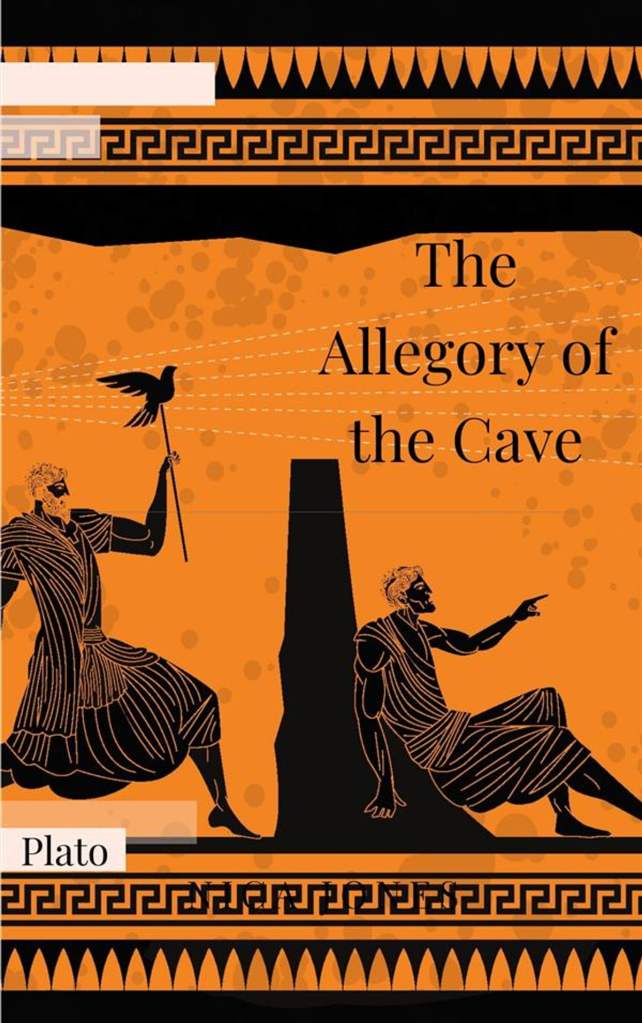
The Cave Allegory
Socrates’ analogy to Glaucon revolves around education, knowledge, and the perceptions of people. Socrates employs an allegory of a cave to describe the educated and uneducated states inherent in human nature.
Allegory of the Cave: Socrates suggests imagining people in an underground cave. The cave has a wide entrance, and inside, individuals are chained by their heads and legs. Behind them, a light from a fire shines, creating shadows of tools and wooden statues carried along a path on the wall between the light and the chains.
People can only look at the wall in front of them, seeing only the shadows. Due to their chains, they cannot turn their heads. This situation symbolizes a state where human perceptions are limited, and they are isolated from the real world.
Perception of Chained Individuals: Socrates explains that the chained individuals live in a world limited to the shadows they see and cannot perceive real objects. They understand only the shadows on the wall based on the sounds and passersby behind the cave. These shadows hinder their understanding of the real world.
Emergence into the External World and Enlightenment: Socrates states that if a person is freed from the chains and ascends, they must first adapt to the light. They need to see shadows, reflections on water, objects, and finally the sun. This represents the journey of acquiring knowledge and enlightenment. As they start seeing the real world, they first understand the shadows, then objects, and ultimately the sun.
Education and Acquisition of Knowledge: Using this analogy, Socrates explains that education is the process of turning the human soul from darkness towards light. Even though people have innate abilities, they must learn to use these abilities and be guided in the right direction.
Uneducated and Educated Individuals: Socrates argues that uneducated or inadequately educated individuals cannot attain the ability to govern the state or reach higher knowledge. He emphasizes that the founders of the state should select and educate those with the best abilities. This process is essential for people to reach genuine knowledge and lead a better life.
Thus, through this analogy, Socrates communicates significant thoughts on education, knowledge, perception, and the pursuit of genuine knowledge to Glaucon. The dialogue includes Socrates discussing the role of philosophers in the governance of the state, emphasizing the importance of their education. Philosophers should be trained not only for their personal needs but also to contribute to the welfare of the state.
Socrates and Glaucon further discuss various branches of knowledge to develop philosophical thinking and organize an educational program. These include:
Mathematics and Geometry: Socrates highlights the importance of mathematics and geometry, stating that mathematical knowledge is valuable for society, especially in the management of the military and war strategies.
Ideal and Real Knowledge: Socrates emphasizes that ideal knowledge should be related to eternal existence. He values knowledge associated with the eternal rather than the formation of knowledge.
Astronomy: Socrates underscores the importance of knowing astronomy for agriculture and warfare, as it involves understanding seasons and months beyond the colorful images in the sky.
Dialectic and Genuine Knowledge: Socrates explains the use of dialectic to reach genuine knowledge. He stresses the significance of intellectual power over observed phenomena in approaching truth.
Pythagoreans and Harmony Teachings: Socrates criticizes the Pythagoreans’ teachings on harmony. Instead of examining mathematical relationships between sounds, he emphasizes the differences in real-world sounds.
Power of Dialectic: Socrates notes that dialectic, as a science, enables looking at the world of existence through the power of thought. He emphasizes that thinking power is fundamental to reaching genuine knowledge, beyond sensory organs.
The Afterlife Er’s Myth
Socrates is delivering a speech to Glaucon regarding the immortality of the soul and the impact of justice on the soul. Socrates argues that the soul cannot be destroyed by internal illnesses or external factors, asserting that the soul is therefore immortal.
Socrates contends that the soul cannot be corrupted by internal evils; rather, external influences, such as injustices, can only affect the soul. He likens this to the way diseases affect the body, explaining that the soul cannot be destroyed by its internal evils but can weaken under the influence of external evils.
Furthermore, Socrates emphasizes the importance of justice to support the immortality of the soul. He states that justice is a virtue that protects and strengthens the soul. Regarding the impact of justice on the soul, he claims that the soul of a just person attains immortality and can transcend beyond the mortal body.
Finally, building upon the concept of the immortality of the soul, Socrates emphasizes the importance of understanding the true nature of the soul. He suggests that the soul should be examined in its pure and natural state, not altered by society, the body, or external influences. By doing so, he argues that the genuine nature of the soul can be better understood, and its relationship with justice can be more clearly comprehended.
The discussion then shifts to the evaluation of individuals as just or unjust and how this is perceived by both gods and humans. Just individuals are said to receive rewards both in this world and the afterlife for their just actions throughout their lives. The rewards in the afterlife are based on the story of Er, describing a place where the soul of a just person is rewarded with a good fate in accordance with their just actions.
The impact of justice on a person’s life and how just actions are rewarded by the gods are emphasized. Unjust individuals, on the other hand, face negative consequences throughout their lives due to their unjust actions being exposed. As they age, they confront difficulties and insults as a result of their unjust behaviors.
Er’s story provides a detailed explanation of the judgment process in the afterlife. The souls of just individuals are evaluated by judges based on their just actions and receive their rewards by following a path ascending to the sky. Unjust individuals, on the other hand, follow a path descending underground, facing the consequences of their unjust actions.
In conclusion, the narrative underscores how just behavior creates value in a person’s life and brings both earthly and afterlife rewards. The character Er narrates the story, providing insights into the choices of souls after death. The story details the consequences of these choices, influenced by past habits and behaviors. It emphasizes the importance of making wise choices to lead a just and virtuous life. Er’s story, describing the transition to the afterlife, the consequences of choices, and the immortality of souls, serves as a profound allegory.
 rtnews