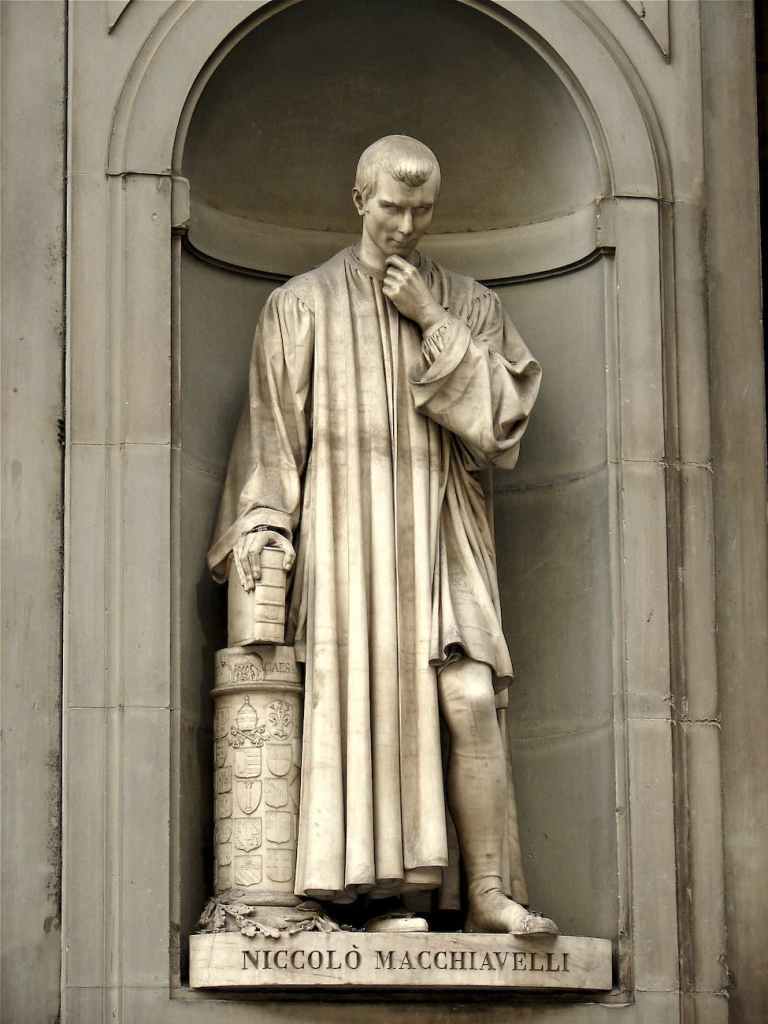
“Just as artists who draw landscapes get down in the valley to study the mountains and go up to the mountains to look down on the valley, so one has to be a prince to get to know the character of a people and a man of the people to know the character of a prince.”
― Niccolò Machiavelli, The Prince
The book “The Prince” written by Niccolo Machiavelli, dedicated to Lorenzo Medici, reveals a completely different aspect of politics and governance, explaining to the reader with numerous examples that both the ruler and the ruled are human beings. In political theory and philosophy, numerous works have been written about the ideal state, and one of the fundamental theories most cited in these works is Plato’s theory of the ideal state. This view has been defended by many philosophers and thinkers throughout the centuries, where rulers are philosopher-kings who see themselves as divine in the eyes of God. This perspective gives rise to a necessity for a definition of a perfect human, but human nature, by its very essence, is flawed, making an ethical political approach based on the ideal state impractical due to human imperfection.
A governance structure aligned with human nature should be developed and implemented based on the current existence and structure of humans, not on how humans ought to be. Humans, by nature, cannot attain perfection; it is an inherent reality, not a matter of choice. Therefore, their deficiencies, flaws, and complexities should be accepted as part of their reality, rather than being judged or vilified. However, most political philosophers, until Machiavelli, have advocated for a close relationship between governance and moral foundations, believing that a legitimate government will emerge when the ruler is morally close to perfection, adhering to traditional ethical principles. Machiavellianism, on the other hand, advocates the opposite view. According to Machiavelli, power and authority are directly related, and embracing a morally good ruler does not guarantee stability in power. Thus, a ruler does not necessarily need to be good and moral to maintain their reign; their sole concern should be to hold and sustain power. The main objective of a ruler is not to establish a good and moral society, but rather to preserve their own power structure for the long term. They should remain composed, portray things that have not happened as if they have, and be selfish. While the concept of being selfish may initially seem negative, it is essential for a ruler to govern a selfish population, as an altruistic ruler would not be able to maintain their power. Machiavelli does not only discuss this in “The Prince” but also in his work “The Art of War,” stating that in politics, there is no region governed by traditional moral rules. According to Machiavelli, embracing a government solely based on moral rules would eventually lead to the destruction of the state. Therefore, a wise prince must be prepared to engage in unethical actions when necessary, but this does not mean that such actions should be displayed outwardly. No matter how unethical an action a prince may take, it should never be projected outwardly. The priority of a prince is to build a lasting political structure and ensure stability. A good ruler should not focus solely on reputation but should be prepared to take the right actions at the right time and be able to look into the future by learning from history. A ruler must be both loved and feared, but this approach will inevitably deviate from reality since both attitudes cannot be simultaneously embraced. When faced with this choice, it is better for a ruler to be greatly feared rather than greatly loved, as this will ensure a longer period of power and domination. In this context, a feared leader, with a set of rules and a system of punishments, can sustain power for an extended period. Humans naturally prefer boundaries and find happiness within them, just like children.
Machiavelli explains the concept of power through animal examples, using the lion and the fox as symbols. The lion is powerful, majestic, and bold but cannot perceive traps, while the fox is cunning, perceptive of traps, and quick but lacks strength. Therefore, a prince must embody both the qualities of the lion and the fox. Additionally, when establishing their political system, a prince should not share it with trusted individuals; rather, they should keep the foundational elements of their regime, their unique aspects, hidden as a personal secret and never trust anyone.
As seen, Machiavelli’s work “The Prince” represents the first realist political approach, focusing not on what humans ought to be but on what they actually are. Contrary to the idealist dialectical approaches and metaphysical attitudes of philosophers like Plato and Aristotle, Machiavelli adopts a different path, basing his ideas on historical examples to control events in the future. In another work, he explains his approach as follows:
“The difference between how one should live and how one does live is so wide that anyone who ignores what is actually done for what should be done learns his ruin rather than his preservation.”
Here, it is shown that a person who approaches an event not as it happens but as it should happen, embracing an idealistic attitude, prepares their own ruin. Instead, a real leader should adopt a pragmatic approach, grounded in reality and firmly rooted in the ground. An utopian attitude does not offer a solution in this context, and rather than resolving the issue, it can lay the groundwork for a negative course of events or cause the existing problem to worsen, leading to the end of a prince’s rule. The adoption of a pragmatic approach is based on providing advice for state governance; Machiavelli, for example, blames mercenary soldiers for Italy’s ruin, thus suggesting the establishment of a prince’s own army loyal to him. A prince with an army formed by mercenaries can never feel completely safe, as it always carries the risk of losing power.
A wise prince desires to be defeated with his own army rather than gaining victory with others’ armies.
05.08.2023
Rana TAGIL
 rtnews